Insulating a flat roof? Where the insulation sits — above the deck (warm) or between the joists (cold) — decides condensation risk, cost and whether it meets regs. Here is the honest guide.
A warm roof puts insulation above the deck, keeping the structure warm and controlling condensation — the recommended build for Winchester flat roofs over heated rooms. A cold roof puts it between the joists and needs careful ventilation to avoid deck rot. Warm roofs cost a little more but last better. Call 01962 809171.
✓ NFRC Registered
✓ Fully Insured
✓ 10-Year Guarantee
✓ Free Quotes
✓ No Hidden Costs
✓ Family Run Since 2003
The choice
Warm Roof or Cold Roof: What’s the Difference?
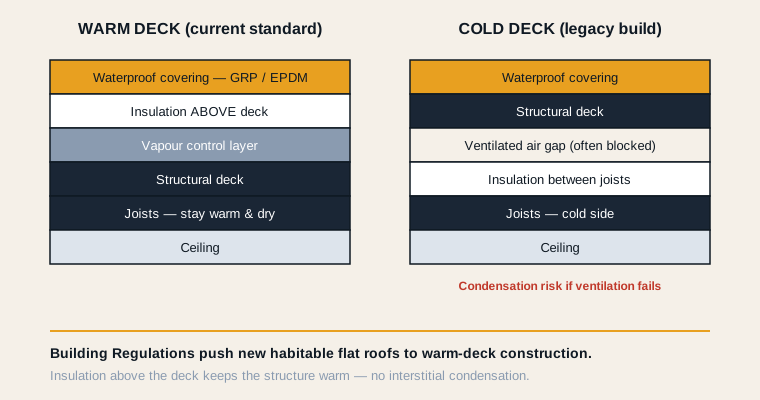
When you insulate a flat roof — an extension, a dormer, a garage conversion — there are two ways to build it. In a warm roof the insulation sits above the deck, directly under the covering, keeping the whole structure warm. In a cold roof the insulation sits between the joists, below the deck, leaving the deck itself cold. The choice affects condensation risk, build height, cost and whether the job meets current building regulations.
For most Winchester flat roofs today the warm roof is the recommended build — here is why, and the honest exceptions where a cold roof still makes sense.
Warm deck (insulation above the deck) vs cold deck (insulation between the joists)Side by side
Warm Roof vs Cold Roof Compared
Factor
Warm roof
Cold roof
Insulation position
Above the deck, under the covering
Between the joists, below the deck
Condensation risk
Low — deck stays warm
Higher — needs a ventilation gap and vapour control
Building regs
Preferred current-practice build
Allowed but harder to get right
Build height
Raises the roof level slightly
No added height
Best for
New flat roofs and re-covers over heated rooms
Where height is fixed and headroom is tight
Performance
Better, more reliable thermal performance
Adequate if ventilation is correct
The core issue is condensation. In a cold roof, warm moist air from the room can reach the cold deck and condense, rotting the timber from beneath — which is why a cold roof must have a continuous ventilation gap and a vapour control layer, and why so many older Winchester flat roofs fail early when those were skimped. A warm roof keeps the deck above the dew point, so the risk largely disappears. It is the more forgiving, more durable build.
Deciding
How to Choose the Build-Up
1. Is the room below heated?
If yes — a kitchen extension, a bedroom under a dormer — a warm roof is almost always the right build for comfort, regs and condensation control. An unheated garage matters far less.
2. How much height do you have?
A warm roof adds 100–150mm to the roof build-up. Where a door threshold, window head or planning height fixes the level, a cold roof (or a thinner high-performance warm board) may be the only option.
3. Are you re-covering anyway?
If the covering is being renewed, adding warm-roof insulation above the deck at the same time is efficient and cheap relative to doing it later — the ideal moment to upgrade.
4. What does building control expect?
For habitable rooms current practice strongly favours the warm roof; we build to the regs and handle the detailing that a cold roof needs to pass.
5. Ventilation reality
If a cold roof is unavoidable, the ventilation gap and vapour control must be continuous and correct — the commonest point of failure. We detail it properly rather than cutting the corner that causes deck rot.
Timescales
How Long the Work Takes
Job
Duration
Warm-roof re-cover, extension
1–2 days
Cold-roof insulation upgrade
1–2 days
Combined with full re-cover
2–3 days
Warm-roof work is timed with the covering; the deck is never left open to weather overnight.
Access
Getting to the Roof
Most flat roofs being insulated are single-storey extensions and garages reached from a tower or ladder. First-floor flat roofs need scaffold, which we itemise and arrange, with any pavement licence obtained from Winchester City Council where the street requires it.
Cost
What Each Build Costs
Work
Typical range
Notes
Warm-roof upgrade (add-on to re-cover)
£800–£2,000
Insulation above deck
Cold-roof insulation
£500–£1,200
Between joists + ventilation
Full warm-roof re-cover, extension
£2,200–£3,500
Covering + insulation
Per m² warm-roof insulation
£25–£45
Board + fitting
What moves the price
Insulation thickness needed to hit the target U-value
Whether it is combined with a re-cover (much cheaper) or retrofitted alone
Worked example: Adding a warm-roof build-up to an 18m² Badger Farm extension during an EPDM re-cover added about £1,100 to the job — far less than retrofitting insulation later, and it transformed the comfort of the room below.
Covering SO22, SO23, SO21 and surrounding postcodes.
Guarantee
Warranties
The insulation boards carry their own manufacturer warranty, the covering carries its warranty (EPDM up to 20 years, GRP 25), and our 10-year workmanship guarantee covers the installation and detailing. A correctly built warm roof is one of the most reliable, low-maintenance roof types there is.
Good to know
Choosing the Covering Too
Warm or cold is the build-up; you still choose the covering that goes on top. For that decision see our EPDM vs GRP comparison. For the full service see flat roofing, and for adding loft or rafter insulation on a pitched roof see roof insulation.
Retrofit reality
Upgrading an Existing Flat Roof
If your flat roof is not being re-covered yet but the room below is cold, you have two realistic routes. The best is to wait until the covering is due for renewal and add a warm-roof build-up then — doing both together is far cheaper than either alone and gives the best result. If the covering has years left and you cannot justify replacing it early, a cold-roof insulation upgrade between the joists is possible, but it must be done with a continuous ventilation gap above the insulation and a vapour control layer below, or you simply move the condensation problem rather than solving it.
This is where a lot of well-meant DIY and cut-price work goes wrong on Winchester extensions: insulation is stuffed between the joists with no ventilation path, the deck goes cold and damp, and within a few years the timber is rotting from beneath. We would rather explain honestly why a cheap cold-roof retrofit can backfire than take the job and leave you with a worse roof. Where a warm roof is the right answer we build it properly; where height genuinely rules it out, we detail the cold roof so it actually works.
On building regulations, upgrading the thermal performance of a flat roof over a habitable room is notifiable work, and the target U-value has tightened over the years. A warm roof reaches it comfortably with standard boards; a cold roof can struggle for depth between shallow joists, sometimes needing high-performance insulation to hit the number. We handle the building-control side as part of the job.
FAQs
Common Questions
In a warm roof the insulation sits above the deck, under the covering, keeping the whole structure warm and largely removing condensation risk. In a cold roof the insulation sits between the joists below the deck, leaving the deck cold, which requires a continuous ventilation gap and vapour control to avoid condensation and rot.
For most flat roofs over heated rooms, a warm roof is better — it controls condensation more reliably, performs better thermally, and is current best practice. A cold roof is mainly used where added roof height is not possible.
Insulating or re-covering a flat roof over a habitable room engages building regulations for thermal performance. A warm roof is the straightforward way to comply; a cold roof can comply but the ventilation and vapour detailing must be correct.
Very often because a cold-roof build-up lacked adequate ventilation or vapour control, so warm moist air condensed on the cold deck and rotted the timber from beneath. A warm roof keeps the deck warm and largely avoids this.
Yes, and it is the ideal time — adding insulation above the deck during a re-cover is far cheaper than retrofitting it later and immediately improves comfort and efficiency.
Yes, by roughly 100–150mm depending on the insulation. Where a door threshold or window head fixes the level, we can use thinner high-performance boards or, if height is truly fixed, a properly detailed cold roof.
Adding a warm-roof build-up to a re-cover typically costs £800–£2,000 depending on size and insulation thickness; a full warm-roof re-cover of an extension runs around £2,200–£3,500. We quote it against your exact roof.