Replacing a flat roof? EPDM rubber and GRP fibreglass both beat old felt — but which suits your roof depends on size, use and weather. Here is the honest comparison from a roofer who fits both.
For a Winchester flat roof, EPDM (rubber) suits large simple roofs and lasts up to 50 years; GRP (fibreglass) suits smaller or walk-on roofs with a hard seamless finish and 25-year warranty. EPDM installs in poorer weather; GRP needs a dry cure. We fit both and recommend by roof. Call 01962 809171.
✓ NFRC Registered
✓ Fully Insured
✓ 10-Year Guarantee
✓ Free Quotes
✓ No Hidden Costs
✓ Family Run Since 2003
The choice
EPDM or GRP: Which Flat Roof Is Right?
If you are replacing a flat roof in Winchester — a garage, a rear extension, a dormer — the two systems worth considering today are EPDM (a single rubber membrane) and GRP (glass-reinforced plastic, or fibreglass). Both far outlast the old bitumen felt they usually replace. The right choice depends on the roof’s shape, size, how it will be used, and the weather window you are working in.
Here is the honest comparison, with no manufacturer bias — we fit both, so we have no reason to push one over the other. For the felt-versus-modern decision specifically, see our GRP vs felt guide.
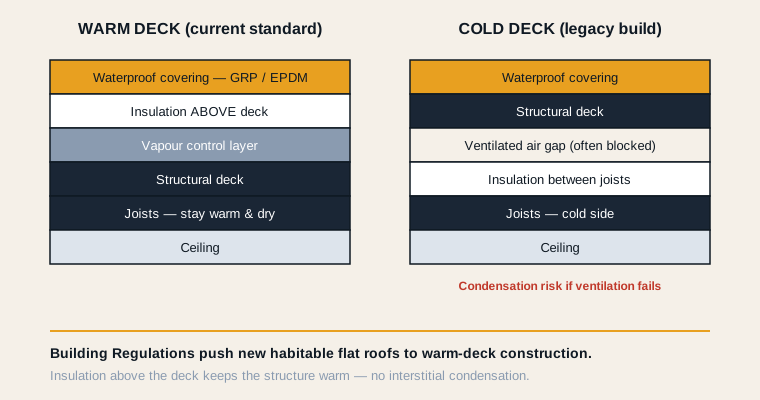
Flat-roof build-up — the deck detail matters as much as the coveringSide by side
On Winchester’s stock the pattern is fairly consistent: for a plain, larger flat roof — a big rear extension or a flat garage roof — EPDM’s single-sheet simplicity and longer life usually win. For a smaller roof, a roof with lots of upstands and penetrations, or anything that will be walked on regularly (a balcony or a flat roof with a roof light), GRP’s hard seamless finish tends to be the better fit.
Deciding
How to Choose Between Them
1. Size and shape
Large and simple favours EPDM (fewer seams, faster lay, longer life). Small and intricate favours GRP (moulds cleanly around detail).
2. Use
Occasional-access garage or extension roof: either works, EPDM edges it on life. Regular walk-on, balcony or terrace: GRP’s harder wearing surface wins.
3. Weather window
GRP needs a dry deck and dry, mild conditions to cure properly, so in a wet spell EPDM is often the more practical choice. We never lay fibreglass onto a damp deck.
4. Budget vs lifespan
GRP is a little cheaper up front on small roofs; EPDM often costs less per year of life on larger ones because it lasts longer. We give you both numbers.
5. The deck underneath
Both are only as good as the deck. If boards have rotted we replace them first — the commonest hidden cost on either system.
Timescales
How Long Each Takes to Fit
Roof
EPDM
GRP
Garage roof
1 day
1 day
Extension 16–20m²
1–2 days
1–2 days
Larger/complex roof
2–3 days
2–3 days
GRP curing is weather-dependent; a wet forecast can push a GRP job but rarely affects EPDM.
Access
Getting to a Flat Roof
Most Winchester flat roofs are single-storey — garages and rear extensions — and are reached safely from a tower or ladder, which keeps cost down. First-floor and higher flat roofs, or larger areas needing edge protection, need scaffold, which we itemise in the quote and arrange, including any pavement licence from Winchester City Council on tighter streets.
Cost
What Each System Costs in Winchester
Job
EPDM
GRP
Garage roof
£900–£1,500
£900–£1,600
Extension 16–20m²
£1,600–£2,600
£1,800–£2,800
Per m² (supply & fit)
£90–£140
£100–£160
Deck board replacement
from £120
from £120
What moves the price
Roof size and number of upstands, outlets and penetrations
Deck condition — hidden rot adds board replacement on either system
Access — first-floor roofs needing scaffold
Insulation upgrade to a warm-roof build-up (see below)
Worked example: An 18m² rear extension in Badger Farm re-covered in EPDM with one replacement deck board came to around £2,300; the same roof in GRP would have been roughly £2,500. Both carry a 20–25 year warranty against the old felt’s 10–15.
Covering SO22, SO23, SO21 and surrounding postcodes.
Guarantee
Warranties on Each
GRP typically carries a 25-year manufacturer warranty and EPDM up to 20 (with a realistic service life beyond that on larger, simple roofs). Our 10-year workmanship guarantee sits on top of whichever you choose. Storm and impact damage remains an insurance matter, which we document for any claim.
Good to know
Do Not Forget the Insulation
Whichever covering you pick, if the flat roof is over a heated room, building regulations and comfort both point to a warm-roof build-up when you re-cover — it is the ideal moment to add insulation above the deck. We cover that decision fully on our warm roof vs cold roof page. For repairs rather than replacement, see flat roof repair, and for the full service our flat roofing page.
Avoid this
The Mistakes That Kill a Flat Roof Early
Whichever system you choose, most flat-roof failures come down to a handful of avoidable errors rather than the material itself. The first is laying a new covering over a soft or rotten deck: the covering may be perfect, but it is only as sound as the boards beneath, so we sound the deck and replace anything springy before a single square metre goes down. The second is skimping on the upstands and outlet detailing — the edges and the drain are where flat roofs leak, not the middle, so both EPDM and GRP need their upstands dressed correctly to a proper height and the outlet bonded in cleanly.
The third is fitting GRP in the wrong conditions. Fibreglass needs a dry deck and a dry, mild curing window; laid onto a damp deck or rushed in poor weather it will not bond properly and can delaminate within a year or two. This is precisely why we sometimes steer a customer towards EPDM for a job that cannot wait for settled weather — it is the honest call, not a cheaper one. Get the deck, the detailing and the weather right, and either system will comfortably outlast the old bitumen felt it replaced by two or three decades.
FAQs
Common Questions
Neither is universally better — it depends on the roof. EPDM (rubber) suits large, simple flat areas and lasts up to 50 years with few seams. GRP (fibreglass) suits smaller or intricate roofs and anything walked on regularly, with a hard seamless finish and a 25-year warranty. We fit both and recommend by roof, not by margin.
EPDM generally lasts longer — up to around 50 years on a well-laid large roof, versus about 25–30 years for GRP. On smaller, detailed roofs the gap matters less and GRP’s finish can be the deciding factor.
They are close. GRP is often slightly cheaper on small roofs and EPDM slightly cheaper per m² on large ones. Measured by cost per year of life, EPDM often wins on big simple roofs because it lasts longer. We quote both so you can compare.
GRP needs a dry deck and dry, mild conditions to cure properly, so a wet or cold spell can delay it. EPDM is more forgiving in poorer weather, which is one reason we sometimes recommend it for a job that cannot wait for a dry window.
GRP. Its hard, seamless surface handles regular foot traffic better than EPDM’s softer rubber, making it the usual choice for balconies, terraces and roofs with a walk-on requirement.
Only if it has rotted. We sound the deck before quoting; where boards are soft we replace them, which is the commonest hidden cost on either system. A sound deck can be re-covered directly.
If the flat roof is over a heated room, yes — re-covering is the ideal time to upgrade to a warm-roof build-up with insulation above the deck, which improves comfort and meets current building regulations. See our warm roof vs cold roof guide.