What Is Nail Sickness — And Does My Winchester Roof Have It?
Nail sickness affects most of the post-war concrete tile roofs across Winchester, Eastleigh and Chandler's Ford. Here's how to spot it and what to do.
Nail sickness affects most of the post-war concrete tile roofs across Winchester, Eastleigh and Chandler's Ford. Here's how to spot it and what to do.
If your home was built between 1945 and 1985 and has concrete interlocking tiles, nail sickness is one of the most likely roofing problems you will face. It is extremely common across the post-war and mid-century housing stock in Winchester, Eastleigh, Chandler's Ford and the surrounding area — and it is almost always invisible until it starts causing problems.
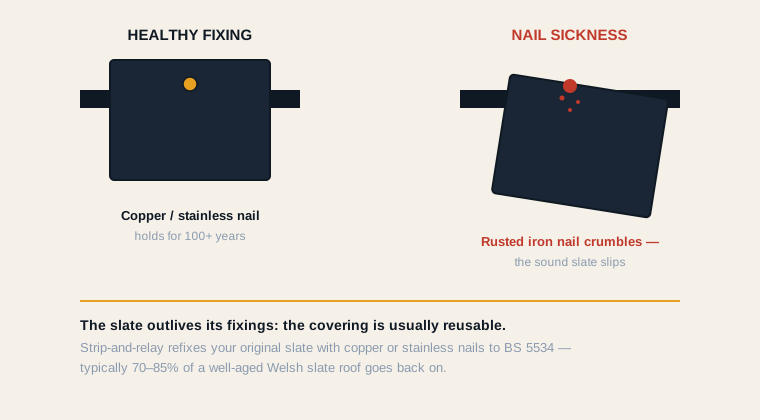
Nail sickness is what happens when the iron nails that fix concrete interlocking tiles to the roof battens corrode and fail. Every tile on a concrete tile roof is fixed with two nails through holes in the tile into a horizontal timber batten. When those nails were made from untreated iron — which was standard practice up to the 1970s — they rust over 40–50 years until they effectively cease to hold anything.
The tiles themselves may look completely fine from the ground. The problem is invisible — the tile sits in place under its own weight and the overlap of the tile above, but it has no fixings. In normal conditions it stays put. In a storm, it does not.
Stand at a safe distance and look at your roof after any storm. If you see tiles that are slightly out of alignment, or tiles that have shifted to show a gap above them, nail sickness is very likely. A single displaced tile is worth investigating.
Nail sickness is concentrated on properties from a specific era: those built or re-roofed between roughly 1945 and 1980 using concrete interlocking tiles. In the Winchester area, this covers:
Victorian, Edwardian and interwar properties are generally not affected — clay plain tiles and Welsh slate were fixed differently, and properties with those roofs have other issues (lead flashings, ridge mortar) but not nail sickness specifically.
The definitive answer requires a close-up inspection — a roofer on a ladder who can actually lift a tile and see whether the nail beneath it has any holding power left. But there are visible signs that warrant getting someone up there:
Suspect nail sickness on your Winchester property?
We offer free surveys with honest, written findings. We will tell you how widespread the problem is and whether repair or re-roof is the right answer.
Book a Free SurveyThis is the key decision, and the answer depends on how widespread the nail failure is across the roof.
If the nail failure is localised — a section of the roof most exposed to the south-west prevailing wind, or one slope that was done at a different time to the rest — targeted repair is both possible and cost-effective. We replace the affected tiles with correct-profile matching tiles and fix them with modern stainless steel clips rather than nails, which will not corrode.
If a survey finds nail failure across the whole roof — which is common on roofs over 50 years old — a partial repair is a short-term solution to a whole-roof problem. We will tell you this clearly: if three-quarters of your tiles have failed fixings, patching the worst quarter will not prevent the rest from coming off in the next serious storm.
A full roof replacement on a 3-bed semi in the Winchester area costs £6,500–10,000 and comes with a 10-year workmanship guarantee. For a 50-year-old roof, this is often the most cost-effective decision.
You can do a basic visual check from the ground or from a loft hatch. From the loft, look at the underside of the roof deck during daylight — any daylight visible around nail positions indicates the tiles have shifted. This is not a substitute for a proper inspection but it gives you an indication.
Do not attempt to get on the roof yourself. Concrete interlocking tiles are not designed to be walked on, and on a nail-sick roof, tiles can move unexpectedly underfoot. A fall from a domestic roof is serious. We offer free surveys — there is no reason to take the risk.
Whatever roofing work your Winchester property needs, these are the mistakes we see most frequently from homeowners who have been through a bad experience:
Accepting a verbal quote. Any job over £300 should have a written, itemised quote. Verbal quotes are unenforceable and tend to grow significantly by the time the invoice arrives.
Paying the full amount upfront. A deposit of 10–25% is standard. Full payment before work is complete removes all your leverage if the work is unsatisfactory.
Not checking NFRC registration. A roofer claiming NFRC membership who is not listed at nfrc.co.uk is not registered. Takes 30 seconds to check.
Choosing on price alone. Three quotes where one is 35% below the others is not a bargain — it is a signal that scaffolding, waste disposal or material quality is being cut from the scope.
Not asking about mortar specification. For Winchester period properties, the wrong mortar causes brickwork damage. Always ask: lime mortar or modified cement?
The next step after reading any roofing guide is a free professional survey. We cover all of Winchester and the surrounding Hampshire area — Eastleigh, Romsey, Chandler's Ford, Bishop's Waltham, New Alresford, Kings Worthy, Twyford, Colden Common, Otterbourne and Compton.
Call 01962 809171 or email info@winchesterroofers.co.uk. Free survey. Written condition report. Same-week appointments. No call-out fee. No obligation.
How many loose tiles indicates nail sickness is widespread enough to re-roof?
A general guide: if a survey finds more than 20–25% of tiles have zero fixing security, full re-roof is likely better value than systematic clip repair. Clip repair is appropriate when sickness is localised — a single elevation, or tiles in specific positions. We confirm the proportion at survey and include both clip repair and re-roof costs in the written report.
Does nail sickness only affect concrete tile roofs?
Iron fixing nails are also used on clay tile and natural slate roofs. However, nail sickness is most commonly discussed in the context of post-war concrete tile estates because the iron nails used on 1950s–70s Winchester properties have corroded particularly aggressively — the tile profile traps moisture, accelerating corrosion relative to clay tile or slate installations.
Can I clip repair nail sickness myself?
Stainless steel tile clips are available from roofing merchants. The access risk of working on a roof without scaffolding or a correctly positioned roof ladder is significant. Professional clip repair also requires checking every tile for fixing security — not just the ones that are visibly loose. DIY clip repair of obviously loose tiles without checking the full roof may address symptoms while missing widespread underlying sickness.
My Winchester property survey says 30% nail sickness. What does this cost to fix?
Clip repair at 30% affected tiles on a 3-bed Winchester semi: approximately £600–£1,200 depending on roof area and access. Full re-roof: £6,500–£10,000. The 10-year cost comparison typically favours re-roof at this level of sickness — clip repair provides 5–10 years of life; a re-roof provides 40–60 years. We include both options in the written survey report.
A nail sickness survey on a Winchester post-war estate property takes 45–90 minutes and covers every tile on all elevations. The surveyor works systematically across each row from eaves to ridge, pressing each tile from above to test fixing security. Tiles with zero fixing security (the nail has corroded completely) move freely when pressed. Tiles with partial security rock slightly. Sound tiles do not move.
At the end of the survey, the proportion of affected tiles is confirmed as a percentage, broken down by elevation and position (eaves tiles tend to fail first due to the higher wind loading at the overhang). The written report classifies: below 15% (monitor), 15–25% (clip repair recommended), above 25% (re-roof assessment recommended).
This percentage classification is the foundation of the repair vs replace decision. We provide this assessment at no charge across all Winchester post-war estates. The report is yours whether or not you proceed with any work.
Stanmore and Abbots Barton: the Itchen Valley moisture accelerates nail corrosion. Properties here typically show sickness 5–10 years earlier than equivalent chalk ridge properties of the same age. A 1965 Stanmore semi may already be at 30–40% sickness; a 1965 Harestock semi at 15–20%.
Teg Down and Harestock: chalk plateau dryness slows corrosion slightly, but wind loading on displaced tiles accelerates failure once nails lose holding. The combination creates a different pattern — fewer affected nails but faster displacement of those that are affected.
Nail sickness is when the iron nails fixing concrete interlocking tiles corrode and fail, leaving tiles loose on the battens. It is extremely common on post-war properties across Winchester, Eastleigh and Chandler's Ford built between 1945 and 1985.
Properties built between roughly 1945 and 1980 with concrete interlocking tiles. This includes post-war estates in Stanmore, Winnall, Boyatt Wood in Eastleigh, and the 1970s–80s commuter estates in Chandler's Ford and Colden Common.
Look for tiles that are slightly lifted or misaligned, tiles that rattle when touched, rust staining below the tile line, tiles in the garden after wind, or a roof that is 45+ years old and has never been inspected.
If nail failure is localised, repair with stainless steel clips is cost-effective. If a survey finds nail failure across the whole roof, full replacement is the correct decision — patching a wholesale failure is expensive short-termism.
You can do a basic visual check from ground level or through a loft hatch. Do not attempt to get on the roof yourself — on a nail-sick roof, tiles can move unexpectedly. We offer free nail sickness surveys across Winchester and Hampshire.
No call-out fees. No obligation. Just an honest quote from a local roofer who knows Winchester's housing stock inside out.
01962 809171