What Is Sarking Felt And When Does It Need Replacing?
Sarking felt is the hidden second layer keeping Winchester roofs dry. Here is what it does, how long it lasts, and what failure looks like.
Sarking felt is the hidden second layer keeping Winchester roofs dry. Here is what it does, how long it lasts, and what failure looks like.
Sarking felt — also called roofing underlay or roofing felt — is the secondary weatherproofing layer on a pitched roof, installed between the tiles on top and the rafters below. Most Winchester homeowners do not know it exists until it fails. When it does, the consequences range from an annoying drip to serious structural water damage. Here is what you need to know.
A tiled roof is not completely watertight. Wind-driven rain, condensation, and water travelling up under lifted tiles can all penetrate the tile layer. Sarking felt is the second line of defence — it catches any water that gets through the tiles and directs it down to the eaves guttering rather than into the roof structure.
On modern breathable felts (the standard on any re-roof since the 1990s), the underlay also manages condensation within the roof space, allowing vapour to pass through rather than accumulating on the cold underlay surface. Original bitumen-based felt from pre-1990 properties is not breathable and requires adequate ventilation to manage condensation separately.
Traditional bitumen-based felt: 30–40 years. Modern breathable polypropylene underlay: 40–60+ years. On Winchester's post-war housing stock — Stanmore, Winnall, Badger Farm, Harestock — the original bitumen felt is now 50–70 years old and has typically failed or is close to failure. When we strip these roofs for re-roofing, finding felt that has completely decomposed is routine rather than exceptional.
On a bright day, look up at the underside of the roof deck from the loft. Daylight visible through pin-holes around nail positions indicates tile movement. Large areas of daylight through failed felt indicate the secondary weatherproofing layer has failed. At that point the tiles alone are keeping the weather out.
On a full re-roof, sarking felt replacement is included as standard. The tile stripping process exposes the felt and battens, which are inspected before the new system is installed. Where the felt has failed and caused moisture damage to the battens, we replace the battens at the same time — new felt over rotten battens is a short-term solution.
The new underlay is a modern BS 5534-compliant breathable membrane, lapped correctly at all joints and turned into the guttering at the eaves. All Winchester re-roofs we carry out use breathable underlay as standard — non-breathable felt is no longer the correct specification for a new installation.
In theory yes — a specialist can replace felt by lifting and relaying tiles section by section. In practice, this approach is rarely cost-effective compared to a full re-roof, particularly on older properties where the tiles and battens also need replacing. The cost differential between felt-only replacement and a full re-roof on a Winchester 3-bed semi is typically £2,000–£4,000 — the additional cost for a complete new roof including tiles, battens and lead work. We discuss both options honestly at survey stage.
Winchester's Victorian and Edwardian properties — Hyde, Fulflood, St Giles Hill, the Cathedral area — were originally built without underlay. Plain clay tiles were laid directly on battens, with lime mortar pointing at the ridge and hips providing the only supplementary weatherproofing. Underlay was typically added when roofs were re-roofed in the mid-20th century, usually with bitumen felt.
When we re-roof a Winchester Victorian property today, the breathable underlay we install is likely the second or third generation of secondary weatherproofing on that roof. The original battens — if not replaced in the 20th century re-roof — are sometimes 100+ years old and are inspected carefully before new underlay is fixed.
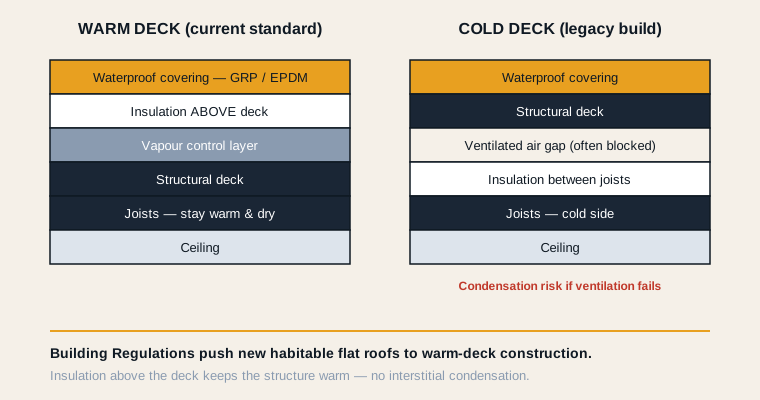
For Winchester homeowners installing loft insulation, the underlay position matters. Traditional cold roof construction (insulation at ceiling joist level) works fine with breathable underlay above. Warm roof loft conversion construction (insulation between the rafters) requires that the breathable underlay is above the insulation — not trapped between insulation and tiles, which prevents the breathable function from working. We advise on the correct specification for each Winchester property at survey stage, particularly where loft conversion or insulation upgrade work is planned alongside re-roofing.
Whatever roofing work your Winchester property needs, these are the mistakes we see most frequently from homeowners who have been through a bad experience:
Accepting a verbal quote. Any job over £300 should have a written, itemised quote. Verbal quotes are unenforceable and tend to grow significantly by the time the invoice arrives.
Paying the full amount upfront. A deposit of 10–25% is standard. Full payment before work is complete removes all your leverage if the work is unsatisfactory.
Not checking NFRC registration. A roofer claiming NFRC membership who is not listed at nfrc.co.uk is not registered. Takes 30 seconds to check.
Choosing on price alone. Three quotes where one is 35% below the others is not a bargain — it is a signal that scaffolding, waste disposal or material quality is being cut from the scope.
Not asking about mortar specification. For Winchester period properties, the wrong mortar causes brickwork damage. Always ask: lime mortar or modified cement?
The next step after reading any roofing guide is a free professional survey. We cover all of Winchester and the surrounding Hampshire area — Eastleigh, Romsey, Chandler's Ford, Bishop's Waltham, New Alresford, Kings Worthy, Twyford, Colden Common, Otterbourne and Compton.
Call 01962 809171 or email info@winchesterroofers.co.uk. Free survey. Written condition report. Same-week appointments. No call-out fee. No obligation.
Traditional bitumen-based felt: 30–40 years. Modern breathable polypropylene underlay: 40–60+ years. Most post-war Winchester estate properties (Stanmore, Winnall, Badger Farm) have original felt now 50–70 years old that has typically failed.
Yes — on a bright day, look up at the roof deck from the loft. Daylight visible in large patches (not just around nail points) indicates felt failure. Debris in the loft — leaves, insects — also indicates failed felt. A roofer on a ladder can assess from outside.
Not necessarily. If only isolated tiles are being replaced, the surrounding felt can be inspected at the same time. If the felt is found to be in poor condition, a full re-roof including felt replacement is likely to be better value than ongoing patching.
BS 5534-compliant breathable polypropylene underlay is the current standard. Non-breathable bitumen felt is no longer the correct specification for new installations. All Winchester re-roofs we carry out use breathable underlay as standard.
Sarking felt, roofing felt and roofing underlay all refer to the same secondary weatherproofing layer installed between the tiles and the roof structure. The term varies by region and trade background.
No call-out fees. No obligation. An honest quote from a local roofer.
01962 809171